

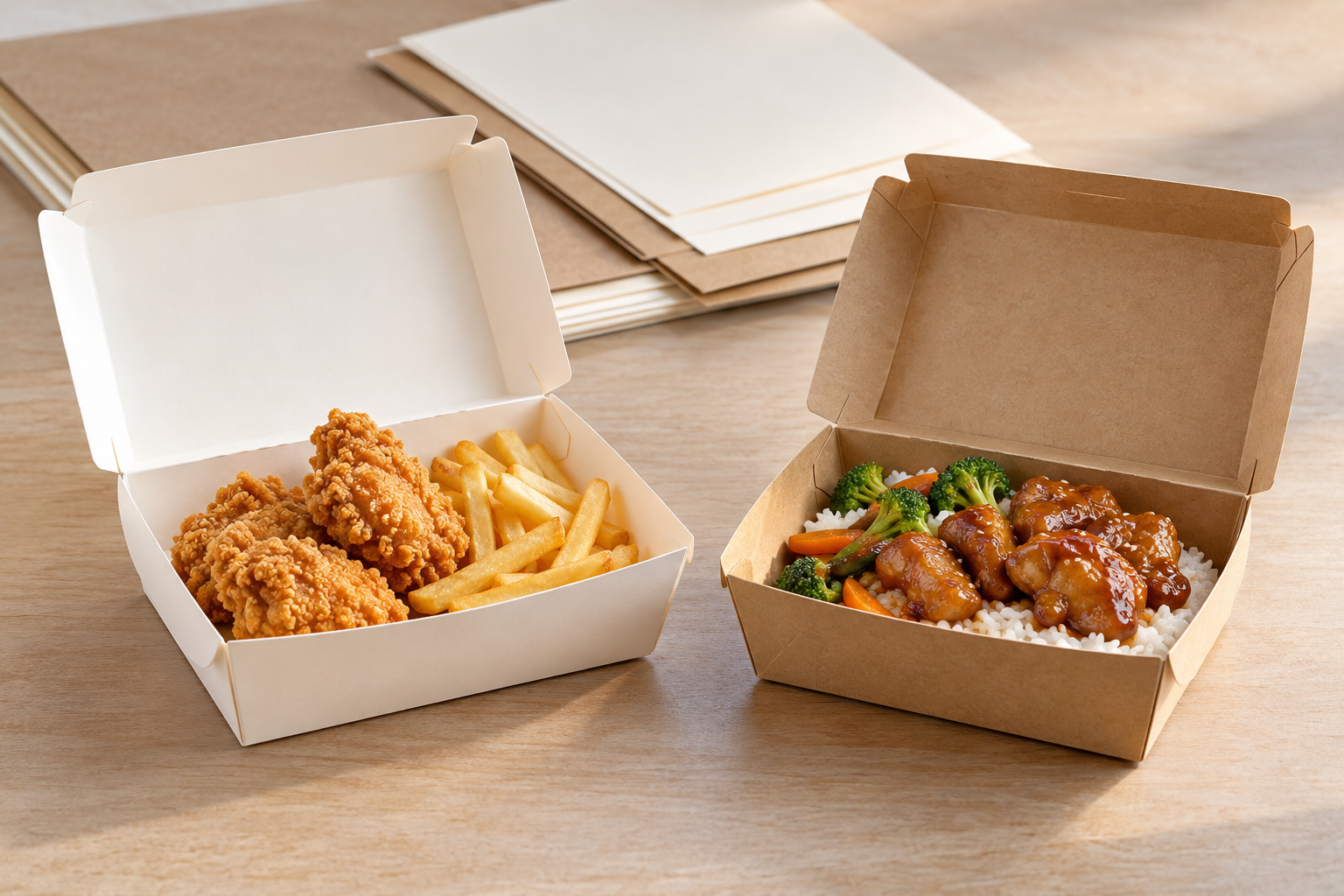
For pastries and ordinary fried-food takeaway, start with a foodservice-grade water-based barrier board. For soup, pooled sauce, and prolonged liquid contact, start with a PE-coated or purpose-designed liquid-barrier construction. For dry bakery products, first check whether you need a barrier at all.
That shortlist can eliminate many unsuitable quotations before you order samples. The next step is to match the shortlisted board to your box design, packing temperature, delivery time, and production line.
| What goes into the box? | First material to quote | Most important approval check |
|---|---|---|
| Dry bread, biscuits, or similar bakery goods | Suitable uncoated board | Food-contact suitability and appearance |
| Butter-rich pastries | Water-based grease-barrier board | Visible staining during the intended holding time |
| Fries, burgers, or unsauced fried chicken | Water-based board specified for hot, greasy food | Oil transfer and fold-line staining after delivery |
| Salad with wet dressing or sauced takeaway food | Liquid-barrier board or PE-coated board | Bottom seam and corner leakage |
| Soup or food surrounded by free liquid | Container construction specified for liquid contact | Filled-container hold and leak test |
| Food intended for microwave reheating | A board and coating specifically rated for reheating | Documented heating conditions for the complete package |
The exception that matters: “Fried chicken” is not one packaging specification. Dry, freshly fried pieces placed in a vented box present a different problem from chicken covered in chili oil and sealed for a long journey. The first is mainly a grease-and-steam decision; the second adds sustained liquid contact and a higher risk of seam leakage.
Aqueous, WBBC, and PE: What Are You Actually Buying?
In supplier quotations, aqueous coating and water-based barrier coating—often shortened to WBBC—are sometimes used as shorthand for the same family of solutions. There is a useful distinction: aqueous tells you how a coating is applied, while barrier coating tells you what it is designed to do. An ordinary water-based surface coating is not automatically an oil- or liquid-barrier coating.
Ask the supplier whether the proposed WBBC is designed primarily for grease resistance, liquid resistance, heat sealing, or a combination. Ask which side of the board is coated and whether the quoted board is the same one used in its test report.
PE-coated paperboard uses a polyethylene layer on the board. It is an established option for moisture-resistant takeaway packaging. Water-based dispersion coatings can also be engineered for grease and liquid resistance. Some commercial grades are designed for short-contact foodservice; others target more demanding liquid applications. The coating name alone does not specify performance. See the Stora Enso barrier-coating overview and BASF's liquid-barrier coating example.

Purchasing rule: Compare named board constructions, not coating categories. “350 gsm board with coating X on the food-contact side” is a specification. “Eco aqueous box” is not.
Which Coating Should You Choose for Fried Chicken?
For ordinary fried chicken without pooled sauce, request a water-based grease-barrier board developed for hot foodservice as your first quotation. Ask for its grease-resistance data and a box formed with the proposed production crease. The goal is to keep oil off the outside of the box throughout the actual delivery period.
This is a practical starting point, not a hypothetical material. Stora Enso describes one specific dispersion-coated foodservice board as suitable for dry and fatty food at temperatures up to 90°C for up to two hours. That is a product-specific specification; it also shows why a blanket claim that all water-based coatings stop working at 85°C would be misleading. View the product application details.
For chicken covered in hot chili oil, change the starting specification. Ask first for a construction designed for sustained oil or liquid contact, often a suitable PE-coated box or a qualified water-based liquid-barrier design. Pay particular attention to the bottom seam and corners. A higher grease rating on a flat sheet will not repair a leaking joint.
For soup or noodles sitting in broth, procure a liquid-holding container, not merely a “grease-resistant takeaway box.” Request a filled-container hold test at the intended serving temperature. If the package will be microwaved, specify that separately. A takeaway-grade PE coating should not be assumed to be oven- or microwave-rated. Board suppliers distinguish PE takeaway grades from materials intended for microwave and conventional-oven trays. See an example of application-specific tray materials.
Give Suppliers a KIT Target—Then Ask the Right Follow-Up
KIT ratings are useful for screening grease-resistant papers. They give buyers a common number to request, even though they cannot predict every food-box failure.
The ranges below are working RFQ starting points, not certified food-to-KIT standards:
| Food application | Initial KIT range to discuss | What must also pass |
|---|---|---|
| Lightly greasy pastries | 4–6 | No unacceptable oil mark over the intended display or delivery period |
| Fries, burgers, ordinary fried chicken | 7–9 | No oil transfer through the formed box during normal delivery |
| Heavy surface oil | 10–12, where KIT is appropriate to the coating | Heated oil-contact and fold-line checks |
Buyer tip: Write the result you need alongside the rating. “KIT 8” is less useful than “KIT result reported under the stated method, plus no visible oil transfer beneath the filled box after our 60-minute delivery trial.”
TAPPI describes the KIT test, T 559, as a surface resistance test using numbered liquids. It also notes that the method was developed primarily for fluorochemical treatments and that its application to film-like or non-fluorochemical barriers needs evaluation. For a water-based coating, ask whether the supplier also has an oil-breakthrough or relevant food-contact test.
The 60-minute requirement in that example comes from the buyer's delivery target. Replace it with your real holding time.
Cobb Values: Ask for the Result and the Test Duration
Cobb measures water absorbed by a paper or board sample over a stated period, expressed in g/m². A quotation saying “Cobb 25” omits a critical detail: was the exposure 60 seconds, 180 seconds, or 30 minutes? Request the method and duration with every result. TAPPI/ANSI T 441 describes the Cobb test for paper and paperboard.
Use Cobb to compare candidate boards under the same test conditions. Then set an approval requirement for your use:
- Pastry box: Prioritize oil staining and appearance. A long water-absorption test may add little to the decision.
- Hot takeaway box: Request a Cobb result and check whether trapped steam softens the closed box during delivery.
- Liquid container: Request the board result, but approve the filled container, including its seam and closure.
A flat-sheet Cobb value is a useful material comparison. It does not show whether the bottom seam of a finished soup container will leak.
Converter Check: Where Does the Barrier Fail After Forming?
Flat-board data helps select candidates. The converting process determines whether the barrier survives as a box.
Crease lines
A crease puts the coating under strain. If oil marks appear along a fold while the panel beside it stays clean, inspect the board-and-coating construction and crease tooling before asking for a higher KIT grade.
In published paperboard tray-forming research, particular dispersion-coated boards performed well in barrier measurements but showed coating damage during forming at industrial processing settings. Process adjustments reduced defects. The factory lesson is to test the proposed finished form.

Converter check: Request finished samples made with the proposed board and tooling. Inspect the critical folds and test them with the actual food. A hand-folded flat sheet does not fully represent a production box.
Bottom seams and corners
If staining starts at a cut edge, examine whether oil is reaching exposed board. If liquid escapes at a seam, check the overlap, adhesive or seal, and assembly. Increasing the flat-panel barrier may add cost while leaving the leak path untouched.
Record the first failure location. “The box failed” is difficult to correct. “Oil followed the front-right crease after 35 minutes” gives the converter a specific problem to investigate.
Machine settings
Do not give a converter one universal heat-sealing temperature for every PE or water-based board. Seal performance depends on the exact material, pressure, dwell time, equipment, and required bond strength. In one published study, its particular water-based coatings formed seals at 80–90°C under the stated experimental conditions. Those numbers are evidence of material variation, not settings to copy onto another machine. Read the research.
If the boxes are glued, request folding and gluing run results. If they are heat-sealed, request a trial at the proposed production settings and record the seal result. For either process, record the stable machine speed achieved with each material instead of assuming that one board must run slower.
The Hidden Financial Math: Cost per Accepted Box
Purchasing teams often compare coated-board prices. Operations teams pay for accepted finished boxes. The numbers can diverge if one board needs slower forming, creates more fold rejects, or requires a structural change.
Request these five figures for each option:
- Material cost per attempted box
- Stable production speed
- Line cost per hour
- Rejection rate after forming and inspection
- Any additional testing, tooling, or setup cost
The following figures are an illustrative calculation, not a market quotation or an industry average:
| Input | PE option | Water-based option |
|---|---|---|
| Material per attempted box | $0.090 | $0.105 |
| Stable output | 10,000 boxes/hour | 9,000 boxes/hour |
| Line cost | $60/hour | $60/hour |
| Reject rate | 1% | 3% |
| Calculated cost per accepted box | $0.0970 | $0.1151 |
In this example, the water-based material price is 16.7% higher, while its calculated accepted-box cost is about 18.7% higher. The speed and rejection figures were chosen to demonstrate the calculation. Substitute your supplier's quoted prices and measured trial results. If both boards run at the same speed and rejection rate, the comparison changes.
Do not automatically subtract an “EU plastic tax saving” from the water-based option. The EU plastics own resource is a contribution calculated for Member States from non-recycled plastic packaging waste. Any actual packaging fees affecting your purchase must be checked in the destination market.
One Trial Before You Sign the Bulk Order
You do not need two full production runs to shortlist materials. Request pre-creased, production-style samples of the constructions that fit your application. Fill them with the actual food.

For a one-hour delivery requirement, record the following:
| Stage | What to check |
|---|---|
| Filling | Food weight, temperature, and amount of free oil or sauce |
| Packing | Lid position, vents, stacking, and handling |
| At 30 minutes | First visible stain, its location, and approximate size |
| At 60 minutes | Oil transfer beneath the box, seam leakage, softening, and shape retention |
Use multiple samples and photograph the same locations on each. Agree on the pass condition before testing—for example, “no liquid leakage and no visible oil transfer onto the carrier bag after 60 minutes.” If a box fails, report the first failure location to the converter.
What to Approve in Writing
Before ordering, record the board grade, coating side and specification, box structure, intended food and temperature, agreed holding-time result, and approved production sample. Request food-contact documentation applicable to the destination market and intended use.
If a recyclability claim matters, request a report on the relevant construction rather than accepting “water-based = recyclable.” Aticelca 501, for example, evaluates the recyclability of specific predominantly cellulosic materials or products. The tested structure and result should support the claim made for the box being purchased.
For EU-bound food-contact packaging, request current material and PFAS information as part of the documentation. The EU Packaging and Packaging Waste Regulation applies PFAS concentration limits to food-contact packaging placed on the market from 12 August 2026.
Send a Brief That a Converter Can Act On
Ordinary greasy takeaway: Start with a qualified water-based foodservice board. Free liquid or sustained sauce contact: Start with a liquid-container construction, often PE-coated, while considering any water-based alternative that meets the same requirement. Microwave use: Specify a complete package rated for that heating method.
Still deciding whether your food box is suitable for a water-based barrier? Send DeChen Printing your food type, filling temperature, approximate oil or sauce content, box dimensions, expected delivery time, order quantity, and current forming or gluing machine model. Ask about the availability of pre-creased comparison samples for a filled-box trial and line check. Those details give your team a defined result to approve before bulk production.